A foreigner can own a condominium unit in Thailand outright, registered in their own name at the Land Office. Land is another matter: the law firm Khonsu Legal calls condos the one type of Thai real estate genuinely open to direct foreign ownership. For almost every buyer, the Condominium Act of 1979 sets two conditions: room in the building’s foreign quota, and money that comes from abroad in foreign currency.
Can a foreigner own a condo in Phuket?
Yes, within the quota. Section 19 of the Act lists five groups of foreigners who may own a unit, among them permanent residents. Most private buyers qualify through the fifth, by bringing foreign currency into Thailand.
Section 19/2 caps foreign ownership at 49% of the total area of all units in a registered condominium; common areas do not count. The remaining quota may fit a 35 square metre studio but not a 120 square metre corner unit, Khonsu Legal warns, so ask for it in square metres. The quota applies to each registered building, not to the whole project. One foreigner may own several units within it, a Department of Lands official told a House committee, the Bangkok Post reported.
When does the Land Office check the quota?
At registration, not when you sign. Under Section 19/3, the applicant tells the land official the buyer’s name and “the proportion of space of apartments already owned” by foreigners, and the buyer proves that foreign currency came in “in the amount of not less than the price of the apartment to be purchased”. Section 19/4 lets the official register the transfer when foreign ownership, counting the buyer, stays within 49%.
Resales move that share, so a building with room at reservation can be full on transfer day. Get a quota letter from the juristic person, the owners’ body that runs the building, before the deposit and again a few days before the transfer.
What if the building’s quota is full?
Then the Land Office registers no new foreign purchase there unless the seller is a foreigner, whose sale leaves the foreign share unchanged, The Thaiger writes. Full buildings are concentrated in parts of Phuket, central Bangkok and Pattaya, it adds. Otherwise Khonsu Legal lists three options: a registered lease in that building, waiting for quota to free up, or another building.
A residential lease is capped at 30 years by Section 540 of the Civil and Commercial Code, and in decision 4655/2566 the Supreme Court held that clauses promising more than 30 years, pre-agreed renewals included, are void beyond the first 30. Price a lease as 30 years of use, Khonsu Legal advises, at a real discount to freehold.
How should the money be sent?
From your own account abroad, in foreign currency, for the Thai bank to convert. For an inward transfer of 50,000 US dollars or more the bank issues a Foreign Exchange Transaction form, the FET form; for smaller amounts, a credit advice and a confirmation letter that the Land Office accepts instead, ThaiLawOnline says.
Send it yourself, not through a spouse or a company, and keep it in foreign currency until it reaches Thailand. The purpose should read “purchase of condominium unit” with the project and unit number. If you pay a developer directly, its bank issues the form in your name. Keep the original, because the bank will ask for it when you sell and send the proceeds abroad.
What is paid at the Land Office, and who pays?
The transfer fee is 2% of the government appraised value. Specific business tax of 3.3% applies to any sale by a company and, with some exceptions, to an individual who sells within five years of buying; otherwise stamp duty of 0.5% applies. Withholding tax is an advance on the seller’s income tax.
The contract decides who carries which charge. In resales the usual split is half the transfer fee each, with the taxes on the seller, ThaiLawOnline says, while developers often put the whole fee on the buyer. The reduced fee of 0.01% for homes up to 7 million baht, extended to 30 June 2027, is for Thai individual buyers only, Tilleke & Gibbins reports. Khonsu Legal tells foreign buyers to budget roughly 1% to 2% of the price for their side.
What does the condo cost each year?
Common area fees are charged by unit area, typically 20 to 70 baht per square metre a month, often a year in advance: a 50 square metre unit at 50 baht pays 30,000 baht a year. The first buyer of a new unit also pays once into the sinking fund for major repairs, commonly 400 to 600 baht per square metre.
Land and building tax is due in April. Residential property is taxed at 0.02% to 0.1% of the appraised value, and an owner who lives in the unit and is registered in its house book is exempt on the first 50 million baht. A rented unit appraised at 4 million baht pays about 800 baht a year, by ThaiLawOnline’s estimate.
What should I check before paying a deposit?
Khonsu Legal’s minimum list, before even a reservation deposit:
- the quota letter, cross-checked at the Land Office;
- a title search for the real owner and any mortgage;
- a recent debt-free letter showing the seller owes no fees;
- the juristic person’s accounts, sinking fund and fee arrears;
- for off-plan, the developer’s completed projects, permits and whether the building will be registered under the Condominium Act at all.
The last point matters in Phuket. Only a registered condominium gives foreigners freehold and a quota, and some projects sold there as condos are legally hotel rooms or rental apartments, where the buyer holds only contractual rights, the firm writes. Most private sales have no mandatory escrow, so ask for a due diligence period with a refundable deposit.
Can I buy through a Thai company?
A genuine Thai trading company may buy a unit, and it counts toward the Thai share of the building, Khonsu Legal says. A company whose Thai shareholders only hold shares for a foreigner is a nominee structure and a criminal offence. In the 2025-2026 enforcement campaign such companies are treated as foreign and the purchase is unwound.
Can I rent the unit out?
By the month or longer, yes. The Hotel Act of 2004 does not count as a hotel accommodation let “for a service charge payable monthly or for a longer period”. In a circular of 6 November 2023 the Department of Lands told provincial governors that condominium units may not be used for hotel business, even with the other owners’ consent, Tilleke & Gibbins reports. Thai authorities have repeated that daily condo rentals are illegal, the Bangkok Post reported, and the Hotel Act fine runs up to 20,000 baht plus 10,000 baht a day.
What happens to the unit if the owner dies?
It passes to the heirs, but the Land Office changes the title only after a court appoints an estate administrator, which normally takes three to twelve months, Aphiwat Law writes. The quota is then checked again. An heir who does not qualify under Section 19, or whose unit would take the building over 49%, must notify the land official within 60 days and dispose of the unit within one year (Sections 19/5 and 19/7).
FAQ
Do I have to be in Thailand for the transfer?
No. A purchase can be completed under a notarised power of attorney, which Khonsu Legal calls routine for foreign buyers.
Has the quota been raised to 75%?
No. In 2024 the cabinet approved only a study of a 75% quota and 99-year leases. No amendment has passed Parliament, say both Khonsu Legal and The Thaiger.
The figures above are as of October 2026. Before you pay, have an independent lawyer, not one recommended by the seller or the developer, check the quota, the title and the contract.
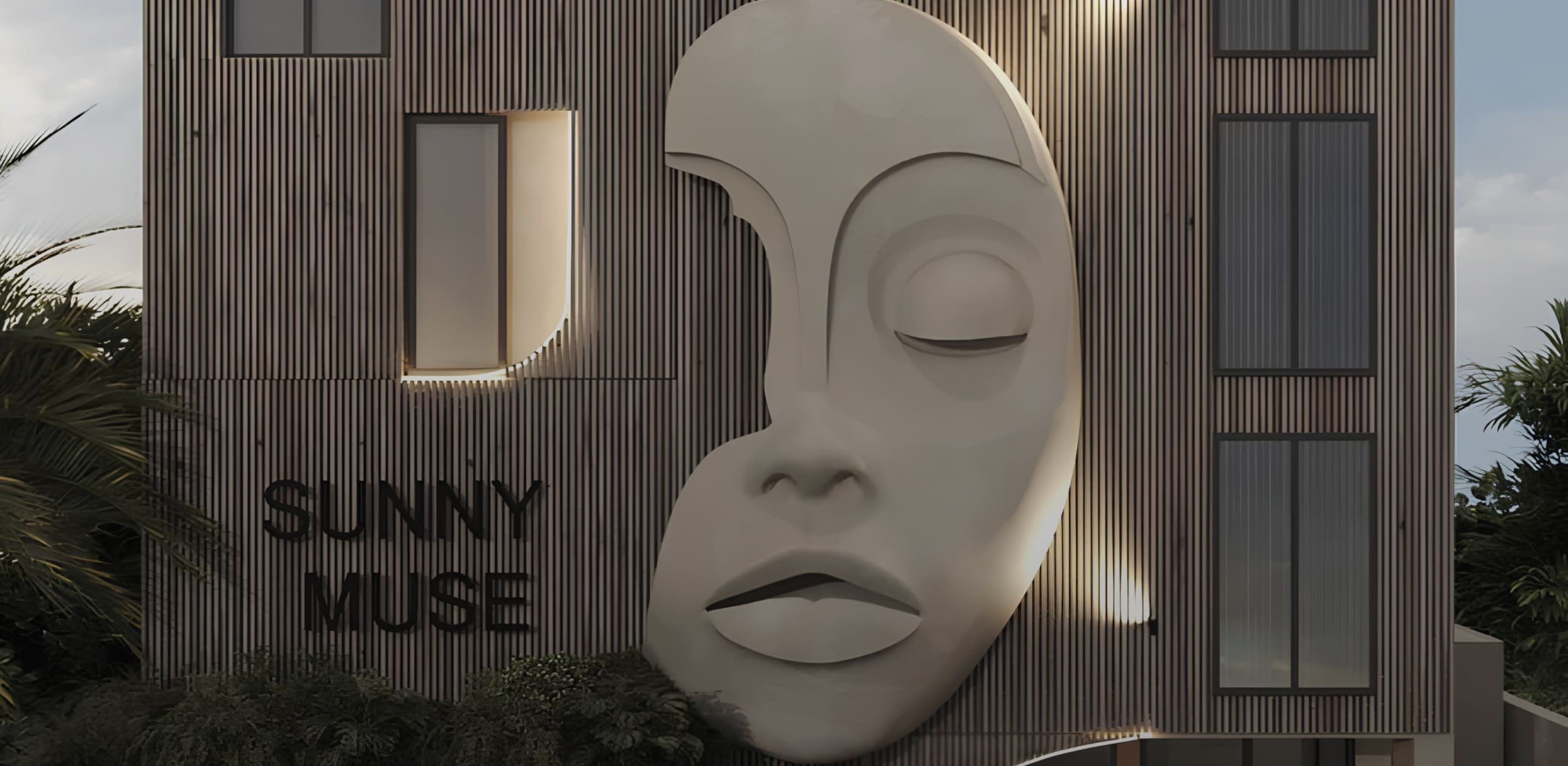
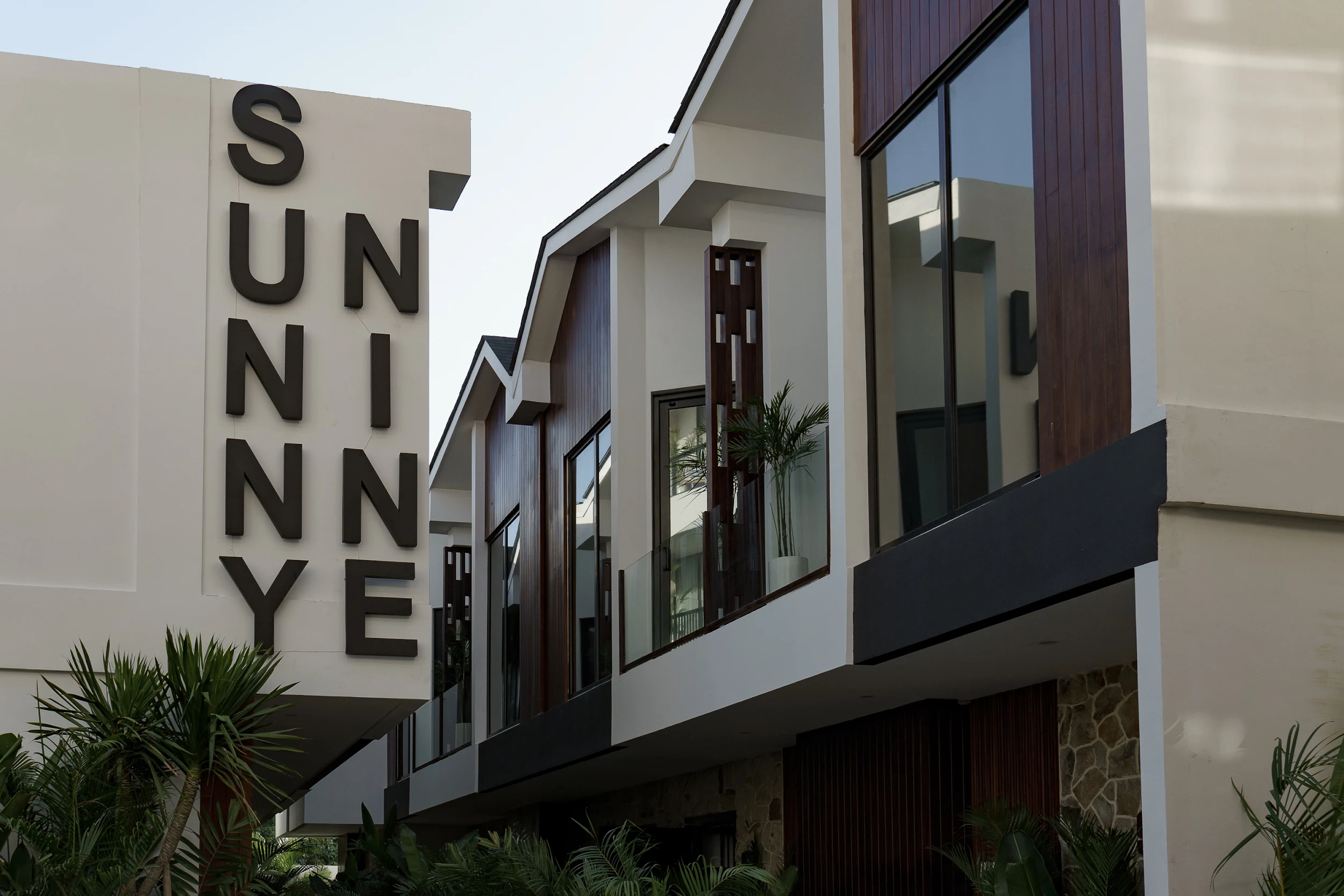
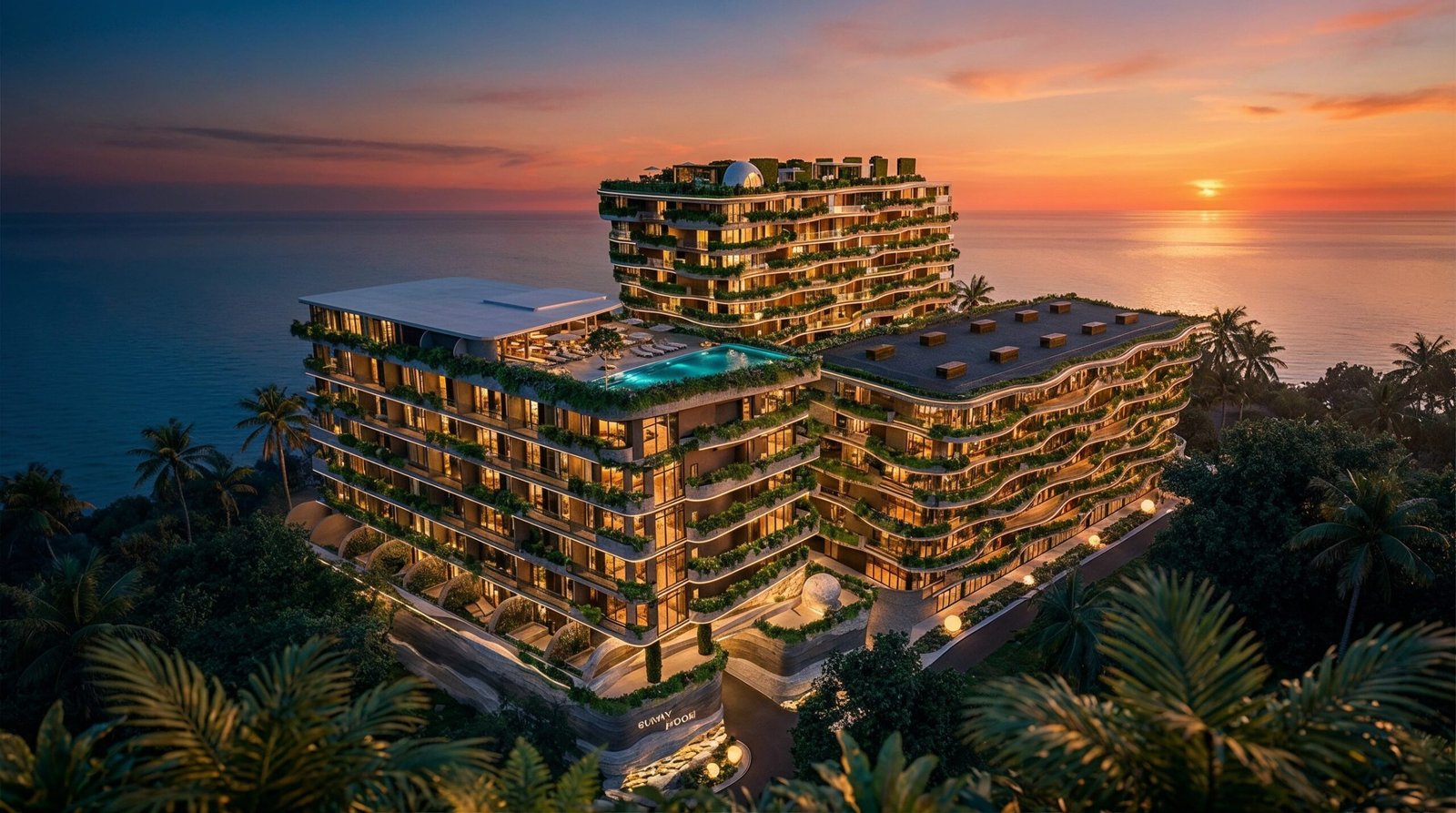
Sunny Development Group has built on Bali and in Phuket and counts its time on the market from 2011. Its Sunny Moon complex in Rawai, Phuket, has 297 apartments in total: 228 in the first phase, which covers the first two buildings, and 69 in the second.
Sources
- Siam Legal: Condominium Act B.E. 2522 (1979), Sections 19 to 19/11, English translation
- Khonsu Legal: Buying a condo in Thailand, the 49% foreign-quota rule explained (2026)
- Khonsu Legal: Property due diligence in Phuket (2026)
- ThaiLawOnline: Property transfer fee and taxes in Thailand
- ThaiLawOnline: FET form
- ThaiLawOnline: Common area fees and sinking fund in Thai condominiums
- ThaiLawOnline: Land and Building Tax Act
- The Thaiger: What Thailand’s 49% foreign quota means for buyers (2026)
- Bangkok Post: Thailand cracking down on illegal daily condo rentals
- Bangkok Post: Foreigners warned over condo rentals
- Thailand Law Online: Hotel Act 2004, English translation
- Tilleke & Gibbins: Thailand, condominiums cannot be used for hotel operations
- Tilleke & Gibbins: Thailand extends reduced property transfer and mortgage registration fees (2026)
- Aphiwat Law: Can a foreigner inherit a condo in Thailand (2026)